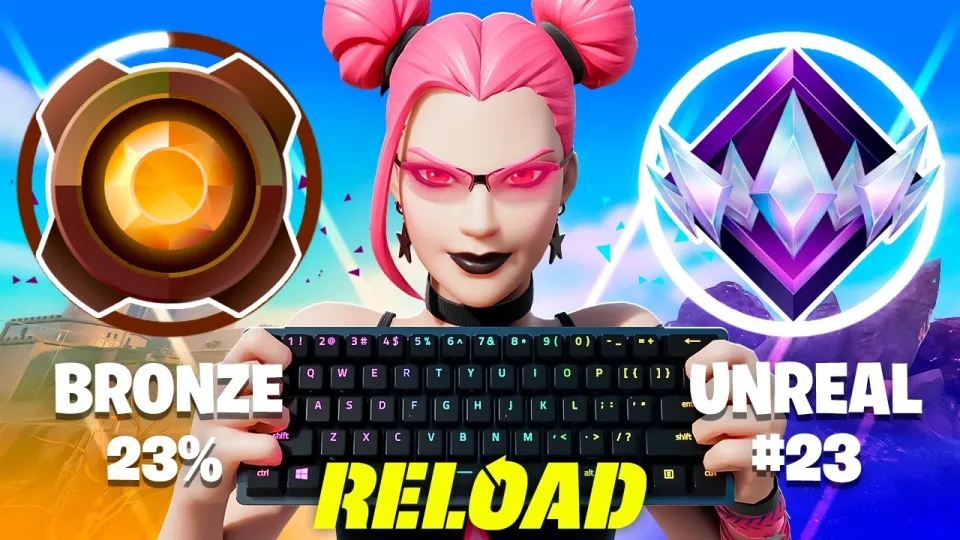
How a Fortnite Bronze to Unreal speedrun works in Fortnite Reload
Want articles like this for your own video to promote it on YouTube and Google? Order them through the Telegram bot @sat_sit_bot. Articles with your video embedded are written and posted by the bot itself — on popular topical sites (no ads). Your first 50 articles are free.
· based on the channel HaloBT
A Fortnite Bronze to Unreal speedrun is a ranked climb where a player starts in the lowest tier of Fortnite Reload and pushes through every division until reaching Unreal, the top rank. It is not a single trick or a glitch: it is a stack of consistent placements, elimination points and efficient match selection compressed into as few games as possible. HaloBT's run starts from Bronze and is played solo on a controller, and the same route is open to anyone who wants to test how fast their fundamentals actually move them up. Practice tools for that climb are collected on HaloBT's Fortnite creator page, where the maps are published and updated first.
What the Fortnite ranked ladder actually requires
Fortnite ranked is built from eight tiers, and each one has three divisions except the top: Bronze, Silver, Gold, Platinum, Diamond, Elite, Champion and finally Unreal. Points come from two places — placement in the match and eliminations — and the balance between them changes as you climb. In Bronze and Silver, almost any finish inside the top half plus a couple of kills is enough to gain. From Platinum upward, the placement requirement tightens and a bad drop costs you progress even if you fought well.
The practical consequence is that a speedrun is a test of consistency, not of highlight plays. A player who finishes top 10 in every game with three or four eliminations will reach Unreal faster than someone who wins one match and dies off spawn in the next three. That is why the ranked climb videos are usually judged by the number of matches played, not by the number of Victory Royales.
Why Fortnite Reload is the faster route to Unreal
Fortnite Reload is a faster ranked mode because its matches are shorter and respawns keep players in the fight longer than a standard Battle Royale game. Fewer minutes per match means more ranked games per hour, and more games per hour means faster point accumulation at every tier where the entry cost is low. Reload also keeps the lobby active until the late stages, so elimination points are easier to collect than in a mode where half the lobby is gone after the first circle.
The trade-off is that Reload rewards aggression differently. Because respawns exist for part of the match, players take fights they would avoid in a normal ranked game, and the player who wins those fights repeatedly builds a points lead quickly. For a speedrun, that is exactly the behaviour you want: controlled aggression early, safe placement late.
The realistic timeline from Bronze to Unreal
A realistic Bronze to Unreal climb depends on three variables: how many points each match returns, how many matches you can play per session, and how often you lose points on a bad drop. There is no fixed number of games, but the shape of the climb is predictable.
- Bronze and Silver: the entry cost is minimal, so almost every match is net positive. This is the stage to play fast and take every fight, because losses barely register.
- Gold: the first real filter. Lobbies mix players with very different habits, and in fills the teammate quality is unpredictable, which is why many viewers describe Gold as the most frustrating tier of the whole run.
- Platinum and Diamond: placement starts to matter more than kills. Landing in a contested spot and dying early now costs points you have to earn back.
- Elite and Champion: the point gap between a top-5 finish and a top-15 finish becomes the deciding factor. Bushcamping stops working; you need both placement and at least a few eliminations.
- Unreal: the final push, where the goal is simply to survive the entry cost long enough to bank a good game.
A dedicated player grinding several hours a day can move through the lower tiers in a matter of days; the upper tiers are where sessions start to feel like work.
Loadout and mechanics priorities for a solo controller climb
Loadout priorities for a solo controller climb are simple: mobility, a reliable close-range weapon, a mid-range weapon and heals, in that order of importance when you are fighting for placement. Mobility decides whether you can rotate out of a bad position; a shotgun decides whether you survive the fight you did not choose. Carrying three weapons and no heals is the most common way low-rank players lose points they had already earned.
Mechanically, the three skills that move rank fastest are edits, piece control and aim consistency. Editing matters because it turns a defensive box into an escape route; piece control matters because it decides who gets the first clean shot; aim consistency matters because a controller player who hits shots at range does not need to take every fight up close. HaloBT's practice map, Elite Aim Edit Piece, is built around exactly those three skills — the code is 6317-4546-8691, and it can also be found by searching the creator name in the Fortnite map browser.
Common questions from players stuck below Unreal
Players stuck below Unreal usually share the same three problems: they play too many matches per session without reviewing any of them, they change their drop spot every game, and they blame teammates for points lost in fills. Fixing the first problem is the cheapest gain — playing ten focused games beats playing thirty autopilot games at every tier above Gold. Fixing the second means picking one landing spot and learning its rotations until they are automatic. Fixing the third means accepting that in fills, the only variable you control is your own decision-making.
A second frequent issue is the feeling that improvement has stalled after switching input devices. Progress on a new input is not linear: the first weeks bring fast gains because basic mechanics are new, then the curve flattens while old habits are unlearned. The way through is deliberate practice on a small number of skills rather than more hours of ranked games.
Useful links
- HaloBT's Fortnite creator page with practice maps and updates: https://www.fortnite.com/@MoreHaloBT
- Community Discord: https://discord.com/invite/halobt
- Twitch streams: https://www.twitch.tv/halobt
- Twitter: https://twitter.com/halobombtrooper
- Instagram: https://www.instagram.com/therealhalobt
What the climb shows about ranked Fortnite
The Bronze to Unreal speedrun is less about raw skill than about removing wasted games. Every tier rewards the same three things — surviving the drop, converting one good fight into a top finish, and not repeating the mistake that ended the previous match. Reload makes that loop faster because matches are shorter, but it does not change the underlying logic of ranked points. HaloBT's run is a useful reference point precisely because it is solo and on a controller, which is the setup most players actually have. If you want to follow the same route, start with the practice maps on HaloBT's creator page and treat each ranked session as a small set of games to review rather than a grind to endure. The channel HaloBT publishes the full run and the map updates alongside it.
Key takeaways
- A Bronze to Unreal speedrun in Fortnite Reload climbs all eight ranked tiers: Bronze, Silver, Gold, Platinum, Diamond, Elite, Champion and Unreal.
- Reload ranked matches are shorter than standard Battle Royale, so more games fit into the same session and rank progress moves faster.
- HaloBT's run starts from Bronze and is played solo on a controller, with no squad carrying the climb.
- Elite Aim Edit Piece by HaloBT is a practice map for aim, editing and piece control; the map code is 6317-4546-8691.
- Gold is consistently the hardest stretch of a low-rank climb because of mixed lobbies and inconsistent teammates in fills.
Source: BRONZE To UNREAL Ranked Speedrun In Fortnite Reload! · Markdown version
Questions & answers
How long does a Bronze to Unreal speedrun take in Fortnite Reload?
There is no fixed match count, because points per game vary with placement and eliminations. Lower tiers move quickly since entry costs are small, while Elite and Champion require consistent top finishes. A player grinding several hours a day can clear the low tiers in days, but the final stretch to Unreal is where most of the time goes.
Why is Gold considered the hardest tier in a ranked climb?
Gold mixes players with very different habits, so lobbies are unpredictable and teammate quality in fills is inconsistent. Points lost on a bad drop are also harder to recover than in Bronze or Silver. Many players report that Gold feels harder than Diamond for exactly this reason.
Do I need a squad to reach Unreal, or can I do it solo?
Solo climbing is entirely possible and is how many speedruns are recorded. Playing solo removes dependence on teammates but puts more weight on your own rotations and placement decisions. Fills can help, but only if you treat your teammate as a bonus rather than a plan.
What should I practice to climb faster on a controller?
Focus on edits, piece control and aim consistency, since those three skills decide most fights in ranked Reload. A dedicated practice map such as Elite Aim Edit Piece (code 6317-4546-8691) covers all three. Playing fewer, more focused ranked games and reviewing them beats long autopilot sessions.